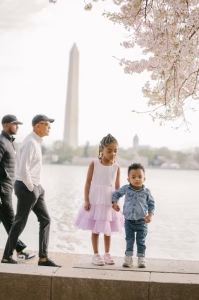
A family’s ordinary spring outing to Washington, D.C.’s iconic Tidal Basin began with all the familiar rhythms of everyday life—borrowing a dress shirt at the last minute, calming a restless toddler, and walking beneath cherry blossoms at the fleeting peak of their bloom. The scene was gentle and almost comically typical of a busy family, with petals drifting through the air like confetti and strangers pausing to smile at the blossoms’ beauty. For Portia and her family, the goal wasn’t to create a perfect image worthy of public attention, but simply to capture a moment together amid the rush of daily life—proof that this calm afternoon existed, full of quiet joy and shared experience. As a photographer lined them up for a shot, none of them noticed the quiet footsteps approaching behind them. Their attention was on each other, on the blossoms, and on keeping their toddler still for even a split second.
The photo session that followed was perfectly imperfect, much like most family portraits with young children. The toddler squirmed and tugged at her sleeves, gazing in every direction but the camera, while Dad laughed in that half-exasperated, half-affectionate way parents often do. The photographer took a handful of pictures and moved on, already focused on the next group beneath the trees. The moment as it happened seemed unremarkable—just one among hundreds taken beneath the soft pink blossoms, blending into the background of laughter, conversation, and the steady hum of tourists enjoying the view. What they didn’t realize was that a passerby had drifted through the frame—someone instantly recognizable to millions—but moving with the unhurried ease of a person simply enjoying a peaceful spring morning.
It wasn’t until that evening, after the household had quieted and the toddler was finally asleep, that Portia sat down to scroll through the day’s photos. She smiled at the familiar imperfections—the crooked collar, the blurred hands, and the blossoms caught mid-fall—but then her scrolling came to a sudden halt. There, in the background of one image, was former President Barack Obama, strolling casually under the trees as if he belonged there. The discovery was surreal, like spotting a figure from a history book wandering inadvertently into a personal memory. Portia zoomed in and out, half-laughing, half-stunned at how such an improbable detail had slipped into what was otherwise an ordinary family snapshot. In that still image, history and the everyday moment intersected in a way few would have expected.
Once the image made its way online, the reaction was swift and overwhelming. Comments and headlines proliferated as people marveled at the coincidence, the symbolism, and the sheer luck of the timing. Friends, strangers, and distant observers found in the photo something both charming and meaningful—a former leader captured casually sharing the same space as an ordinary family on a beautiful spring day. Yet for Portia, the online buzz was only a backdrop to a much deeper personal impression. Her connection to the photo wasn’t rooted in its virality, but in its gentle reminder that history isn’t only found in textbooks, monuments, or official speeches; sometimes it walks unannounced through our own moments, just as she was distracted by a borrowed shirt and a restless child.
In the days that followed, the image lingered with Portia in quieter ways, reshaping how she thought about the past and her own place within it. The former president—once the holder of the nation’s highest office and a figure of global policy and consequence—was present in that single snapshot, sharing the same path, breathing the same spring air, and passing through the same moment as her family. What made the photo so compelling was not merely the fame of the unexpected figure in the background, but the intersection of the public and private, the historic and the everyday. It suggested that history is not a distant force that acts upon ordinary lives from afar, but something woven into those lives—found in shared spaces, overlapping stories, and unplanned encounters that quietly shape how we perceive our own stories.
Long after the fleeting internet attention faded, what remained with Portia and her family was a quiet sense of wonder. The photo became a cherished story they would tell again and again—not because of who appeared in the background, but because of what the moment represented. Under the cherry blossoms, amid laughter and mild chaos, their ordinary day brushed against something larger, and then continued forward. It served as a gentle reminder that life’s most meaningful moments are often unannounced, hiding in plain sight. History doesn’t always arrive with fanfare or ceremony. Sometimes it simply walks by you under a canopy of pink blossoms, leaving behind a quiet story—unexpected, unforgettable, and deeply personal.