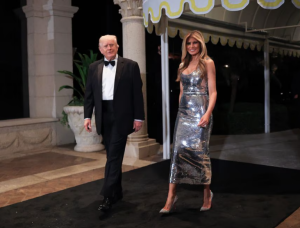
The New Year’s Eve celebration at President Donald Trump’s Mar‑a‑Lago estate in Palm Beach, Florida, was a high‑profile gala that rang in 2026 with both glamour and political spectacle. Hosted at the historic club’s opulent surroundings, the event drew a mix of political figures, celebrities, and socialites, all arriving in formal attire to celebrate the end of the year. The party featured music, food, and festive décor befitting one of South Florida’s most talked‑about holiday gatherings, and it garnered attention on social media with attendees posting photos and reaction threads. Among the noteworthy guests was Israeli Prime Minister Benjamin Netanyahu, who attended alongside the Trumps and was spotted watching fireworks and joining in the festivities.
A central focus of the evening was the appearance of First Lady Melania Trump, who entered the celebration in a dazzling silver sequined gown that immediately drew media and public attention. Her metallic, floor‑length dress — reported to be by The New Arrivals and featuring striking shimmer and sculpted silhouette — contrasted with the warm lighting of the venue and emphasized the celebratory tone of the night. Fashion commentators noted how the gown’s sleek design and light‑reflecting fabric lent both modernity and classic evening elegance to her look, making it a defining style moment of the evening.
Beyond the gown itself, Melania’s overall styling — from understated accessories to graceful hair and makeup — reinforced the polished and coordinated aesthetic of her ensemble. Commentary on social platforms reflected a spectrum of reactions: admirers praised her elegance, how the outfit balanced blaze and sophistication, and how it complemented the formal setting; critics, however, viewed some elements as overly flashy or unconventional for the event’s décor. These mixed reactions were widely discussed on social media, where threads and hashtags about her fashion dominated timelines shortly after the party.
Images and videos of Melania Trump in her silver gown quickly spread across platforms, sparking engagement both supportive and critical. Some responded with admiration for the glamour and confident presence she projected, noting that her look suited the celebratory and upscale nature of the New Year’s Eve gala. However, others — including fashion and entertainment commentators — described various outfits at the event, including Melania’s, as examples of over‑embellished or “tacky” party attire. This generated further debate on how public figures are perceived for style choices and how fashion becomes a talking point in political and social contexts.
While Melania’s appearance dominated much of the fashion coverage, the party itself featured a lively atmosphere with guests mingling, enjoying musical performances, and partaking in festivities that ranged from fireworks to charity auctions. In addition to international attendees like Netanyahu, performers such as rapper Vanilla Ice were on the bill, drawing a mix of praise and online mockery for entertainment choices. At least one online discussion thread noted that the musical performances at the event were widely roasted on social media, reflecting the diverse array of reactions the evening generated.
Overall, the Mar‑a‑Lago New Year’s Eve celebration underscored the intersection of political prominence, social spectacle, and cultural commentary. For many observers, Melania Trump’s silver gown stood out not just as an outfit, but as a visual statement that encapsulated the evening’s blend of formality, celebrity, and fashion narrative. Even as reactions ranged from praise to critique, the event highlighted how highly visible appearances by public figures continue to influence media discourse, cultural conversation, and the broader perception of high‑profile gatherings in modern American social life.