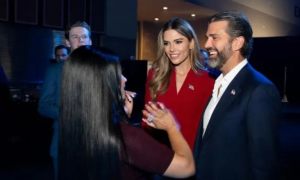
After the announcement of Donald Trump Jr.’s engagement to socialite Bettina Anderson, Kimberly Guilfoyle — Trump Jr.’s former fiancée — issued a measured and composed public statement that emphasized goodwill rather than emotion. In an interview published January 4 with The New York Times, Guilfoyle said she is “happy for Don” and “wishes him, of course, all the best.” She kept her comments brief, careful, and neutral, avoiding personal reflection or criticism. Her restrained tone stood out amid a media landscape often fueled by speculation and emotional reactions, especially given her past engagement to Trump Jr. from 2018 until their split in 2024. Observers noted that her words appeared deliberately chosen to maintain dignity and avoid fanning controversy.
The engagement of Trump Jr. and Bettina Anderson was publicly confirmed in December 2025 when President Donald Trump announced it at a holiday event. The news formalized what had already been a subject of public curiosity, with the couple having been seen together publicly beforehand. Trump Jr. and Guilfoyle were engaged for several years — their engagement began in 2020 — before ending their relationship in 2024. Their breakup was widely described as amicable and relatively low‑key compared with earlier Trump family relationship news. This backdrop has shaped how the public interprets Guilfoyle’s response, viewing it not as a sudden reaction but as part of a longer pattern of restraint and discretion.
Even though Guilfoyle’s public comment was polite and supportive, several media reports citing unnamed insiders suggest the situation may be more emotionally complex behind the scenes. Sources told People that while Guilfoyle and Trump Jr. have remained on friendly terms since their separation and have maintained mutual respect, she may privately harbor mixed feelings about his engagement to Anderson. According to those accounts, she has “major concerns” about whether Trump Jr.’s new relationship is right for him and “isn’t convinced Bettina is well‑suited for Don.” These private sentiments have not been confirmed by Guilfoyle herself, but they reflect how public narratives often probe beneath polished statements in high‑profile breakups.
Guilfoyle’s continued connection to the Trump family also adds nuance to public interpretation of her response. Reports indicate she remains viewed positively within that circle and has not been entirely distanced following her split from Trump Jr. According to People, sources say the Trump family continues to hold Guilfoyle in high regard due to her longstanding involvement and loyalty, bolstering goodwill despite the personal change. This dynamic may partly explain her careful tone: public criticism or visible resentment could disrupt socially and politically significant relationships that persist despite the end of the romantic engagement. Compared with many high‑profile separations, her continuing cordial connections to figures around Trump Jr. suggest blurred boundaries between personal and public life for individuals connected to prominent political families.
Meanwhile, Trump Jr.’s relationship with Bettina Anderson has moved more fully into public view. The couple’s engagement, revealed by President Trump in December, was described by Trump Jr. as a meaningful moment, with Anderson calling herself “the luckiest girl in the world” upon accepting the proposal. Coverage suggests that members of the Trump family approve of the relationship, reinforcing a sense that the engagement is being embraced rather than merely tolerated. This widespread show of familial support has contributed to a narrative framing the engagement as a new chapter rather than a point of controversy — a context that may have influenced Guilfoyle’s decision to keep her remarks cordial and forward‑looking.
Ultimately, Guilfoyle’s public remarks appear to reflect a conscious choice to maintain composure and control her narrative while avoiding the pitfalls of oversharing or public confrontation. Her brief, courteous statements — *“I’m happy for Don” and “I wish him all the best” — demonstrate a desire to acknowledge change without being defined by it. In an era when personal reactions can be rapidly amplified and dissected across social media and news platforms, her restraint stands out as a strategic and self‑protective choice that prioritizes professionalism. Regardless of whether more complicated emotions exist privately, Guilfoyle’s public stance reinforces an image of dignity and composure, underlining how silence, brevity, and courtesy can be powerful tools for public figures navigating personal transitions under intense scrutiny.