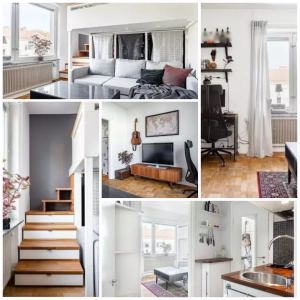
After his divorce in 2020, a Swedish man made what he believed was a temporary and practical housing decision: he left the large suburban family home to his former wife and children and purchased a compact studio-style apartment in the city. The choice felt emotionally neutral, even modest—an interim solution while he adjusted to life alone. His goals were simple and pragmatic: reduce expenses, live efficiently, pay off the mortgage quickly, and eventually move on to a larger space once life felt more settled. Friends and family viewed the move through the same lens, assuming the small apartment was a transitional stop rather than a destination. Yet from the moment he began living there, the experience defied expectations. Instead of feeling diminished or constrained, he felt calm, grounded, and unexpectedly empowered. The apartment did not symbolize loss or compromise; it offered clarity. What was meant to be a short-term adjustment quietly became a meaningful shift, challenging his assumptions about comfort, success, and what he truly needed to feel at home.
As time passed, his perception of the apartment evolved. What he initially labeled as “small” gradually came to feel intentional and complete. Every square meter had a purpose, and nothing existed without reason. The apartment was thoughtfully divided into functional zones that flowed naturally into one another, creating a sense of wholeness rather than limitation. A sleeping area provided privacy and rest, while the living space encouraged relaxation without excess. A compact yet efficient kitchen met daily needs, and a designated work area allowed him to focus without blurring the boundaries between work and personal life. Rather than feeling boxed in, he experienced a rare sense of cohesion, where each part of the home supported the others. The absence of clutter and unused space became a source of relief. Cleaning was easier, organization was intuitive, and the mental weight of maintaining too much simply disappeared. Over time, the thought of “upgrading” faded. The apartment no longer felt like a stepping stone—it felt sufficient.
One of the most striking features of the apartment was its intelligent approach to storage, a challenge that often undermines small living spaces. Instead of relying on bulky wardrobes or visible clutter, storage was seamlessly integrated into the apartment’s structure. The staircase exemplified this philosophy, functioning not only as a vertical connection but also as a series of concealed drawers and compartments. Shoes, seasonal items, and everyday necessities were tucked away discreetly, preserving the open feel of the space. Shelving units were placed with intention, each assigned a clear role rather than becoming catchalls for disorder. Every item had a home, and nothing competed for attention. This thoughtful design eliminated visual noise while allowing the apartment to remain deeply personal. Visitors were often surprised by how spacious the apartment felt, a reaction that underscored how perception is shaped less by square footage and more by design. The space felt calm, lived-in, and deliberate—proof that order and warmth can coexist.
The dining area emerged as one of the apartment’s most meaningful spaces, despite its modest size. Rather than treating it as an afterthought, he designed it with care and purpose. Soft lighting, balanced proportions, and carefully chosen furniture transformed it into a place for presence rather than efficiency. Meals became slower and more intentional, replacing rushed or distracted eating with moments of quiet reflection. The dining space also became a setting for connection, hosting guests who quickly forgot they were seated in a small apartment. Conversations lingered, and the room fostered a sense of intimacy that larger spaces sometimes lack. This area came to symbolize a broader change in his life—a shift away from accumulation and toward appreciation. Comfort was no longer defined by abundance, but by how a space made him feel. The apartment did not demand sacrifice; it simply redefined what richness and satisfaction looked like.
The kitchen further challenged conventional assumptions about small-space living. Compact yet fully functional, it demonstrated that limitation does not equal inadequacy. Appliances were selected for practicality rather than size, and their placement made cooking intuitive and enjoyable. Counter space was optimized, storage extended vertically, and no area was wasted. The kitchen supported daily routines without frustration, allowing him to cook comfortably and efficiently. Guests who expected inconvenience were often surprised by how welcoming and usable the space felt. The kitchen reinforced a central lesson of the apartment: thoughtful planning matters more than square footage. Rather than feeling constrained, he felt supported by a layout that anticipated his needs. The space proved that good design is not about having more, but about making what you have work better.
Ultimately, what began as a temporary post-divorce solution evolved into a lasting philosophy. The apartment became a reflection of a changed mindset—one rooted in minimalism, intention, and self-awareness. Living with less did not feel like deprivation; it felt like freedom. The space offered clarity, reduced stress, and a renewed sense of control over daily life. It challenged deeply ingrained beliefs about success, comfort, and progress, showing that downsizing does not have to signal failure or retreat. Instead, it can mark arrival. By choosing to stay, he didn’t simply adapt to small living—he embraced it. The apartment became proof that a well-designed, thoughtfully inhabited space can provide more than enough, not just physically, but emotionally and mentally as well.