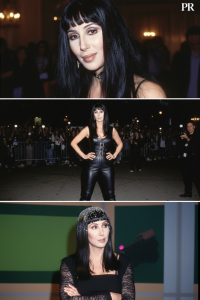
Cher has carved a singular path through more than half a century of Hollywood, defying conventional expectations of fame, beauty, and aging. In an industry often hostile to women over a certain age, she has remained visible, outspoken, and unapologetically present. While cosmetic procedures, beauty standards, and debates over “natural” aging dominate media discussions, Cher’s philosophy offers a rare counterpoint: she never claimed to possess effortless youth, nor did she pretend that time stood still. Instead, she approached her appearance as she did her music and fashion—something to shape, experiment with, and control. This combination of rebellion and self-ownership has allowed her to outlast generations of trends, navigating decades under intense public scrutiny while remaining true to herself. From 1960s studio portraits to high-definition red carpets in the digital era, Cher has consistently treated her body as her business, her choices a testament to autonomy rather than vanity.
In the mid-1960s, before superstardom fully crystallized, Cher’s presence was magnetic and unconventional. Long, straight black hair framed her sharp features, and her expressive eyes revealed both vulnerability and boldness. Early portraits from recording sessions, press conferences, and television appearances show a young woman discovering her own authority and charm. At that stage, media focus centered largely on her music and partnership with Sonny, not on cosmetic alterations or appearance. Yet as her career grew, scrutiny shifted subtly toward her looks. Cher responded not with retreat but with engagement: she honed her style, experimented with makeup, and learned that personal presentation could become a form of creative expression. Reinvention, even at this early stage, became an empowering strategy, signaling that change could be both deliberate and transformative.
By the late 1970s, Cher entered an era defined by flamboyance and fearless fashion. With Bob Mackie’s couture, feathered headdresses, glittering bodysuits, and theatrical gowns, she turned every public appearance into a spectacle. Her image became inseparable from her artistry, cementing her status as a style icon and risk-taker. Yet as she transitioned into serious acting roles in the early 1980s, attention intensified. She won critical acclaim and major awards, but the press increasingly speculated about her appearance, framing cosmetic discussion as part of her narrative. While male contemporaries aged into “distinguished” roles, women faced relentless pressure to maintain youth. Cher refused to conform: she leveraged visibility, embraced bold fashion, and reframed scrutiny into performance, demonstrating that reinvention could be empowering, not a sign of insecurity.
By the 1990s and 2000s, cosmetic procedures and tabloid culture intersected, turning celebrity appearance into a near-constant focus of speculation. Photos across album launches, award shows, and charity events fueled rumors of surgeries, injectables, and impossible alterations. Cher addressed the conversation with characteristic bluntness, acknowledging past procedures like nose and teeth work while pushing back against exaggeration. Her transparency reframed public dialogue: cosmetic choices were not secrets, confessions, or shameful; they were personal decisions, consistent with her larger philosophy of autonomy and control. This approach normalized the idea that enhancement can coexist with authenticity, framing her refreshed appearance as deliberate, practical, and self-directed rather than a concession to age anxiety.
Through the 2010s and into the 2020s, Cher continued to perform, tour, and appear at high-profile events, maintaining the same dynamic energy that defined her early career. While discussions of her looks persisted, her own attitude remained consistent: aging was not a crisis but a fact to navigate. She acknowledged facelifts and cosmetic choices with humor and pragmatism, emphasizing lifestyle, curiosity, friendships, and self-knowledge as key factors in staying vital. Cher’s message was simple: she would not pretend to be younger than she was, nor let the world dictate her terms. By focusing on self-determination, she offered an alternative model in a celebrity culture obsessed with anti-aging, demonstrating that confidence, style, and personal authority outweigh the obsession with perfection.
Recent discussions have been amplified by AI-generated images imagining Cher without cosmetic interventions, juxtaposing “natural” aging against her chosen look. Yet these comparisons underscore her central point: her story is not about preserving untouched youth, but asserting ownership over her body, image, and career. Each decision, from hairstyle to facial contour, reflects intention, era, and comfort, rather than societal pressure. Cher’s radical honesty—refusing to apologize, hiding nothing, and continuing to perform on her own terms—illustrates a broader truth: longevity in public life comes from self-knowledge, adaptability, and unapologetic authenticity. Her career and appearance are inseparable testaments to agency in a culture that often seeks to erase women’s visibility as they age.
In the end, Cher’s enduring presence is not the result of flawless skin or perfect lighting, but the confidence to declare, simply, “This is me.” Across decades of scrutiny, speculation, and changing standards, she has maintained a philosophy of self-possession, humor, and reinvention. Her story reframes cultural conversation around aging, celebrity, and beauty, emphasizing choice over expectation, authenticity over denial, and ownership over compliance. For generations of fans and observers, Cher remains a singular figure: irrepressible, self-determined, and boldly herself, proving that longevity and influence in Hollywood are defined less by physical perfection than by the courage to live fully on one’s own terms.