As Bad Bunny’s Super Bowl halftime performance drew to a close, the Grammy Award–winning artist delivered a moment that was easy to miss but impossible to forget. After a whirlwind of music, choreography, symbolism, and celebrity cameos, the Puerto Rican superstar held up an American football and revealed a short message written across its surface: “Together we are America.” It was a quiet gesture compared to the explosive visuals that had come before it, yet it landed with remarkable force. In a stadium filled with tens of thousands of fans and broadcast to millions more around the world, the football became a canvas for an idea about unity, identity, and belonging. The message appeared at the precise moment when viewers were most attentive, as the performance transitioned toward its finale. Rather than ending on spectacle alone, Bad Bunny chose to close with intention. The simplicity of the phrase stood in contrast to the complexity of the national conversation it addressed, offering a reminder that even the largest stages can be used for subtle reflection. By placing the words on a football—arguably one of the most recognizable symbols in American culture—he fused music, sport, and social commentary into a single, lasting image.
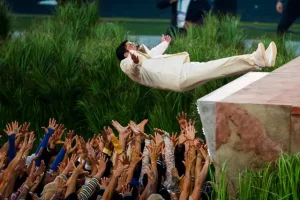
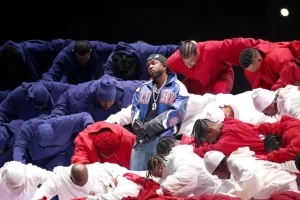
Bad Bunny’s appearance at the Super Bowl was historic long before that final gesture. He became the first solo headliner to perform an entirely Spanish-language set at the NFL’s biggest event, a decision that immediately sparked debate. Some viewers expressed frustration that no subtitles were provided, while others celebrated the moment as a breakthrough for Latin music and representation. Regardless of where audiences landed, the performance itself was undeniably ambitious. It unfolded as a vibrant journey through Latin American culture, blending reggaeton, salsa influences, theatrical staging, and intricate choreography. The set design evoked sugarcane fields and neighborhood streets, while dancers and performers filled the field with motion and color. Bad Bunny moved confidently through it all, dressed in white and commanding the stage with the ease of an artist fully aware of his global reach. The language barrier, for some, faded into the background as the rhythms and visuals took over. For others, it served as a reminder that American culture has never been monolithic. In choosing not to translate his lyrics, Bad Bunny made a statement in itself: that music does not always need to be explained to be felt, and that Spanish-speaking audiences deserved to see themselves centered on a stage that has historically catered to English-speaking norms.
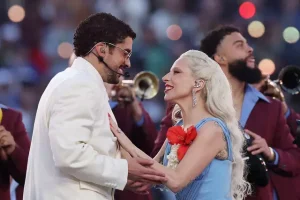
The performance was also packed with star power, further cementing its place in Super Bowl history. Lady Gaga emerged as a surprise guest, drawing a massive reaction from the crowd and viewers at home. Ricky Martin’s appearance added another layer of Latin pop legacy, while Pedro Pascal was spotted dancing among the performers, delighting fans who caught the subtle cameo. These appearances were not random; they reinforced the celebratory tone of the set and highlighted the broad cultural reach of Bad Bunny’s world. Rather than overshadowing him, the guests complemented the narrative he was building—one of community, collaboration, and shared joy. The cameos felt organic, woven into the performance rather than dropped in for shock value. Together, they helped transform the halftime show into something closer to a cultural event than a standard concert. Yet even amid the glamour and excitement, Bad Bunny remained focused on delivering a message that extended beyond entertainment. The football he carried throughout much of the performance initially seemed like a playful nod to the sport, but in hindsight, it was clearly a deliberate prop, one that would ultimately anchor the show’s most talked-about moment.
The phrase “Together we are America” did not appear in a vacuum. It echoed sentiments Bad Bunny had expressed just days earlier at the Grammy Awards, where he used his acceptance speech to criticize Immigration and Customs Enforcement raids and to defend immigrant communities. Standing on the Grammys stage, he declared, “ICE out. We’re not savage, we’re not animals, we’re not aliens—we are humans, and we are Americans.” That message reverberated throughout his Super Bowl performance, even when it went unspoken. The football slogan distilled that broader argument into four simple words, making it accessible to an audience that might not follow his interviews or speeches. It framed American identity as collective rather than exclusionary, suggesting that unity is built through shared humanity rather than language, race, or origin. The timing of the gesture, amid heightened political tension and ongoing debates about immigration and national identity, ensured that it would be interpreted through a political lens by many viewers. Yet the message itself was not confrontational. It did not name specific policies or politicians. Instead, it offered an inclusive definition of America, one that invited people in rather than drawing lines.
Reactions to the halftime show were swift and polarized. Many fans praised Bad Bunny for his confidence, creativity, and willingness to use the platform to express values of unity and love. Social media filled with comments from viewers who admitted they did not understand the lyrics but felt energized and moved by the performance nonetheless. “I couldn’t understand a word, but I loved every minute,” one fan wrote, while another joked, “Idk what bro is saying but it’s lit.” Spanish-speaking fans, meanwhile, expressed pride at seeing their language and culture showcased without compromise. However, the performance also drew sharp criticism, most notably from President Donald Trump. Shortly after the show ended, Trump took to Truth Social to condemn it as “absolutely terrible” and “an affront to the Greatness of America,” complaining that “nobody understands a word this guy is saying” and criticizing the dancing as inappropriate. His remarks fueled further debate, turning the halftime show into a flashpoint in the ongoing culture wars. Ironically, Trump’s reaction amplified the very message he seemed to reject, drawing even more attention to Bad Bunny’s call for unity and inclusion.
In the end, the image that lingered most from the night was not the fireworks, the celebrity cameos, or even the controversy, but the football held up to the camera with its handwritten message. “Together we are America” encapsulated the essence of Bad Bunny’s approach to the Super Bowl: bold without being bombastic, political without being prescriptive, and deeply rooted in personal conviction. The football itself was a powerful choice, symbolizing a sport that brings together people from vastly different backgrounds every year for a shared ritual. By inscribing his message onto that object, Bad Bunny placed his vision of America at the literal center of the event. Whether viewers embraced or rejected the sentiment, they were compelled to engage with it. In a media landscape often dominated by noise and outrage, the restraint of the gesture made it resonate even more. Long after the final whistle and the postgame analysis, that small, subtle message continued to circulate online, sparking conversations about culture, identity, and what it truly means to belong. In that sense, Bad Bunny achieved something rare: he transformed a fleeting halftime moment into a lasting cultural statement