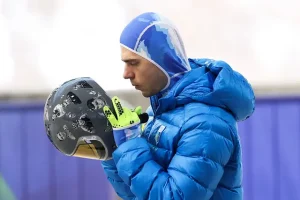
The controversy surrounding Ukrainian skeleton racer Vladyslav Heraskevych erupted after he was banned from competing at the 2026 Winter Olympics because of a custom helmet he designed to honor fallen Ukrainian athletes killed during Russia’s invasion of his country. What began as a deeply personal tribute quickly escalated into an international dispute about free expression, political neutrality in sport, and the limits imposed by Olympic regulations. Heraskevych, 27, had spent years preparing for the Games in Milan-Cortina, only to see his Olympic aspirations halted over what he described as an act of remembrance rather than protest. For many Ukrainians, his exclusion symbolized a painful clash between personal grief and institutional rules designed to preserve political neutrality on the world’s largest sporting stage.
Heraskevych’s helmet featured the images of numerous Ukrainian athletes, coaches, and cultural figures whose lives were lost in the war. Among them were weightlifter Alina Perehudova, boxer Pavlo Ischenko, ice hockey player Oleksiy Loginov, actor-athlete Ivan Kononenko, diving coach Mykyta Kozubenko, shooter Oleksiy Habarov, and dancer Daria Kurdel. Each had been admired within Ukraine’s sporting community, and their deaths left profound gaps in their respective disciplines. For Heraskevych, placing their faces on his helmet was not a political message but a symbolic act of carrying their memory with him as he represented his country. He viewed the tribute as a moral responsibility — a way to ensure that those who could no longer compete would still, in spirit, share the Olympic stage.
However, officials from the International Olympic Committee (IOC) and the International Bobsleigh and Skeleton Federation (IBSF) ruled that the helmet violated Olympic guidelines, specifically Article 50 of the Olympic Charter, which prohibits political, religious, or racial demonstrations at Olympic venues. Although Heraskevych insisted his gesture was commemorative rather than political, governing bodies interpreted the tribute within the broader context of an ongoing geopolitical conflict. When asked to modify or remove the images, he refused, stating that doing so would dishonor those he sought to remember. His refusal led to a ban from competition, a decision that shocked supporters who saw the ruling as overly rigid and insensitive to the human dimension of his actions.
Determined to fight the decision, Heraskevych appealed first to the IBSF jury, which upheld the ban. He then brought the case before the Court of Arbitration for Sport (CAS), the independent body that resolves global sports disputes. Observers recognized that the outcome could set an important precedent regarding athlete expression during times of war. Yet, just hours before his final scheduled runs in the skeleton competition, CAS dismissed his appeal, effectively ending his Olympic campaign. The timing intensified the emotional impact, as years of preparation concluded not on the ice track but in a legal ruling.
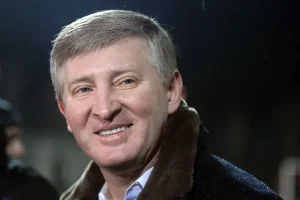
In the aftermath of his exclusion, a powerful supporter stepped forward: Rinat Akhmetov, owner and president of Shakhtar Donetsk. Akhmetov pledged more than $200,000 — roughly equivalent to the financial reward Ukraine grants Olympic gold medalists — to support Heraskevych’s athletic career and mission of remembrance. In his statement, Akhmetov described the athlete as a “true winner,” emphasizing that although he was denied a chance to compete, he had earned respect and pride from his nation. The donation served both as financial backing and symbolic recognition, signaling that moral conviction and national solidarity can carry as much weight as medals.
The incident has sparked widespread debate about the balance between neutrality and personal expression at international sporting events. IOC representatives, including spokesperson Mark Adams, reiterated the importance of maintaining the Games as politically neutral ground, while acknowledging the emotional realities athletes face in times of conflict. As a compromise, the IOC permitted Heraskevych and others to wear black armbands as a general sign of mourning, though this concession did not reverse his ban. Supporters argue that athletes cannot be expected to detach from the realities shaping their lives, particularly when war directly affects their communities. Critics of Heraskevych’s stance maintain that strict neutrality preserves fairness and unity in global sport. Regardless of perspective, the episode has transformed Heraskevych into a symbol of resilience for many Ukrainians. Though he left Milan-Cortina without competing, his actions underscored the complex intersection of sport, memory, and national identity — reminding observers that some of the most powerful statements in athletics occur not through victory on the podium, but through courage in the face of adversity.