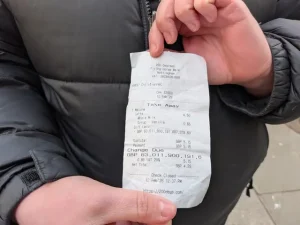
A woman from Nottingham briefly appeared to become the richest person in the world—at least on paper—after an astonishing technical glitch turned a simple coffee voucher into a fictional fortune. Sophie Downing, a 29-year-old entrepreneur, had received a £10 gift card for the coffee chain 200 Degrees as a Christmas present. Expecting nothing more than a complimentary drink, she visited her local branch to buy a matcha latte. Instead of displaying a small remaining balance, the point-of-sale system showed an extraordinary figure: more than £63 quadrillion (£63,000,000,000,000,000). The amount was so vast that it instantly eclipsed not only the fortunes of the world’s wealthiest individuals but even the economic output of entire nations.
To grasp the scale of the number, comparisons quickly followed. The displayed balance dwarfed the net worth of billionaires such as Elon Musk and Bill Gates, exceeding their fortunes many times over. In fact, the figure was exponentially larger than the UK’s annual GDP and even surpassed estimates of the total value of the global economy. The sheer size of the sum rendered it almost abstract—less a realistic amount of money and more a numerical anomaly. For a brief moment, Sophie technically possessed more “wealth” than any person in modern history, though the number existed only within the confines of a coffee shop’s payment system.
Sophie described the moment of discovery as surreal. When the cashier scanned the card, he appeared confused by what he saw on the screen but told her she could proceed. It wasn’t until she reviewed the receipt that the magnitude of the balance fully registered. What had begun as an ordinary coffee purchase suddenly felt like stepping into a fantasy scenario. Yet the absurdity of the figure quickly became apparent: despite its astronomical value, the gift card was limited strictly to purchases at 200 Degrees locations, covering only drinks and food items such as lattes and pastries. It could not be transferred, withdrawn, or used outside the coffee chain.
Recognizing the obvious error, Sophie chose not to exploit the situation. Although she theoretically could have used the card to purchase enormous quantities of coffee products, she refrained from doing so. She speculated that the glitch may have resulted from a barcode scanning mistake that translated into a wildly inflated balance. Rather than “clearing the shelves,” she decided it would be wrong to take advantage of what was almost certainly a technical fault. Her reaction highlighted an important ethical dimension: even when presented with what appeared to be limitless resources, she prioritized fairness and integrity over personal gain.
The coffee chain has not publicly clarified how the error occurred, but the story quickly captured public attention. Online discussions ranged from humorous speculation about buying entire cities’ worth of coffee to broader reflections on how digital systems can produce extreme and sometimes nonsensical results. In an era increasingly dependent on automated transactions and data-driven platforms, the incident served as a reminder that even sophisticated systems are vulnerable to glitches. What seemed like unimaginable wealth was, in reality, a harmless but dramatic display error.
Ultimately, Sophie remains grounded in her everyday life as the owner of her business, Secret Sugar Club. While the world briefly marveled at her “quadrillion-pound fortune,” she treated the situation with humor and responsibility. The episode underscores the contrast between perception and reality in the digital age: a number on a screen may suggest unimaginable riches, but true wealth lies in character, judgment, and integrity. Sophie’s response transformed what could have been a scandal into a lighthearted story about honesty prevailing over temptation.